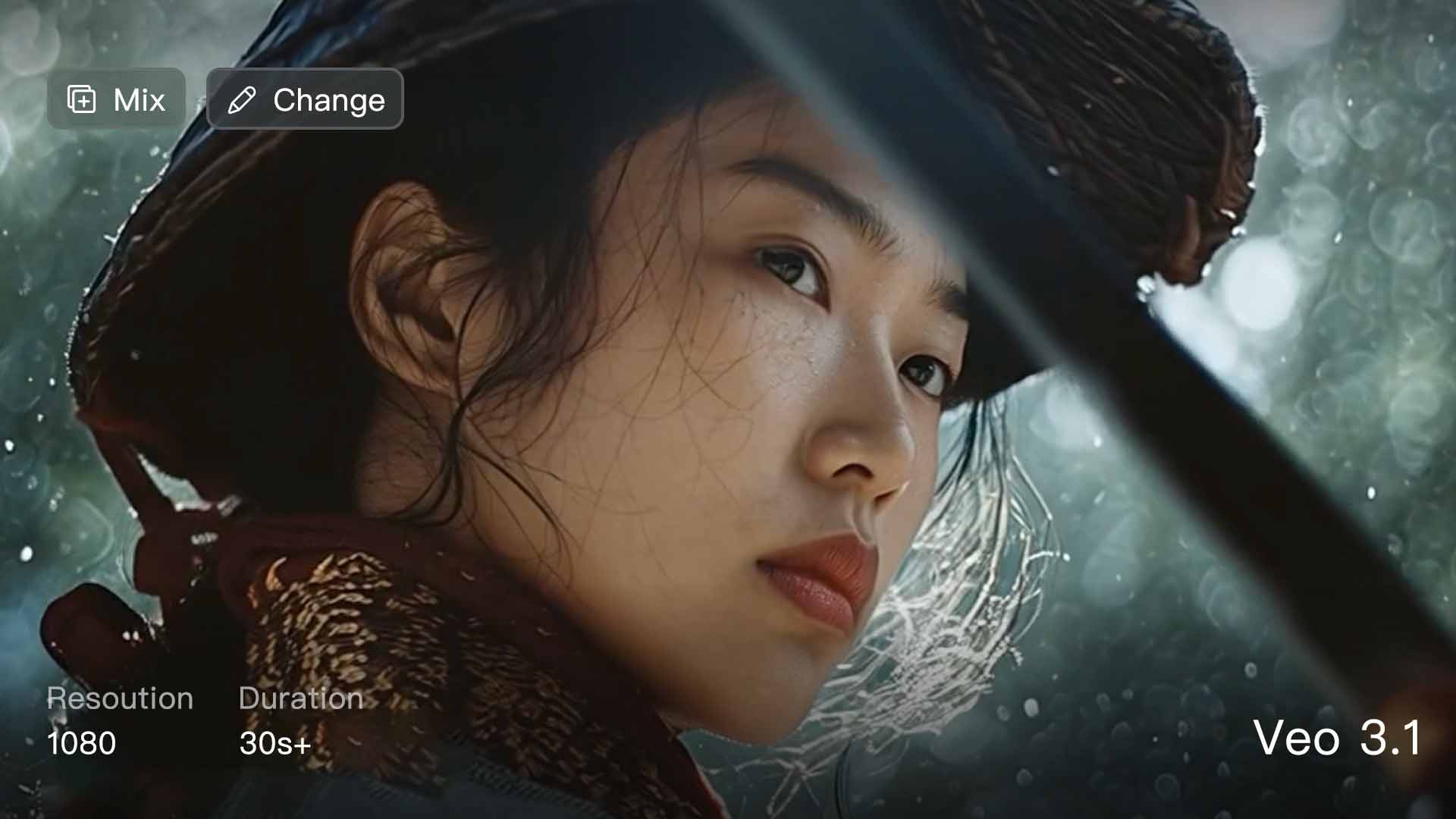
Veo 3.1 features and capabilities are set to drive a major shift in creative technology. Built as the ultimate tool for AI video and image generation, Veo 3.1 transforms complex creative prompts into cinematic AI outputs. It delivers state-of-the-art performance for creators, automatically synchronizing audio, providing perfect lip-sync, generating dynamic voiceovers, and applying adaptive sound effects in a single polished output. With support for longer video durations and flexible large-scale production, Veo 3.1 reduces generation time compared to other resource-intensive systems, letting creators push AI animation and photorealistic rendering further.
What Veo is
Veo is Google’s line of generative video models (DeepMind / Google Cloud / Gemini family). These models turn text or images into short videos. Veo 3 also generates native audio, including sound effects, ambient sounds, and dialogue. Developers and enterprises access Veo 3 through Google Cloud (Vertex AI / Gemini API). Veo 3 adds built-in SynthID watermarks to all outputs.
What Veo 3 already brought
- Converts text → video and image → video, including preview generation.
- Generates native audio: music, ambient sounds, and dialogue.
- Offers two variants: high-quality Veo 3 and Veo 3 Fast (optimized for speed).
- Available on Vertex AI / Gemini API with general availability updates in mid-2025.
- Ensures safety and provenance by adding SynthID watermarks and controlling generation for sensitive content.
So — what is Veo 3.1 expected to bring?
Google has not released an official Veo 3.1 product page. However, multiple developer posts, community posts, and tweets suggest a near-term incremental update. Specifically, Veo 3.1 will focus on improving audio, video quality, and format support rather than rewriting the model entirely.
Based on community posts and Veo 3 characteristics, we can infer several likely improvements:
- Improved native audio: Cleaner dialogue, multi-voice lip-sync, and better sound effect mixing and spatialization.
- Faster and cheaper outputs: More Veo 3 Fast parity and optimizations for common generation paths.
- Better image→video fidelity: Enhanced character and pose consistency in multi-frame clips.
- Expanded aspect ratios and resolutions: Flexible 9:16 / 16:9 support and 1080p across configurations.
- Longer clip durations: Veo 3 currently optimizes 8-second clips; Veo 3.1 may allow longer videos.
- Extended image→video support: Improved realism and motion continuity, building on Veo 3’s preview functionality.

Compare Veo 3 / (expected) Veo 3.1 → OpenAI Sora 2
Primary focus
- Veo 3 (Google): Produces short, high-fidelity 8-second videos from text or image prompts. Generates native audio and integrates with Gemini API and Vertex AI. Optimized for production use and developer pipelines.
- Sora 2 (OpenAI): Flagship video+audio model focusing on physical realism, coherent motion, and synchronized dialogue and sound. Includes a consumer app (Sora) with cameo/consent integration and strong safety controls.
Strengths
- Veo: Strong developer and enterprise integration, production pricing options, vertical/1080p support, and a fast variant. Ideal for businesses building automated pipelines.
- Sora 2: Exceptional physical accuracy, multi-modal synchronization, and social app integration. Suitable for creators seeking realistic narrative scenes and a consumer-facing ecosystem.
How to access Veo now — and how to be ready for Veo 3.1
- Try in Gemini (consumer / web / mobile): Veo generation is exposed in the Gemini apps (tap the “video” option in the prompt bar). Access level (Pro / Ultra) affects which Veo variants you can use.
- Programmatically / enterprise: use API in A2EAPI (Veo model IDs available in the model docs). A2EAPI provides veo3-pro, veo3-fast and veo3. For details, please refer to Veo 3 ‘s doc.
Practical tip (developer): to request vertical output, set the aspectRatio parameter (e.g. "9:16") and check the model configuration (Veo 3 vs Veo 3 Fast) and your plan for resolution limits (720p vs 1080p).