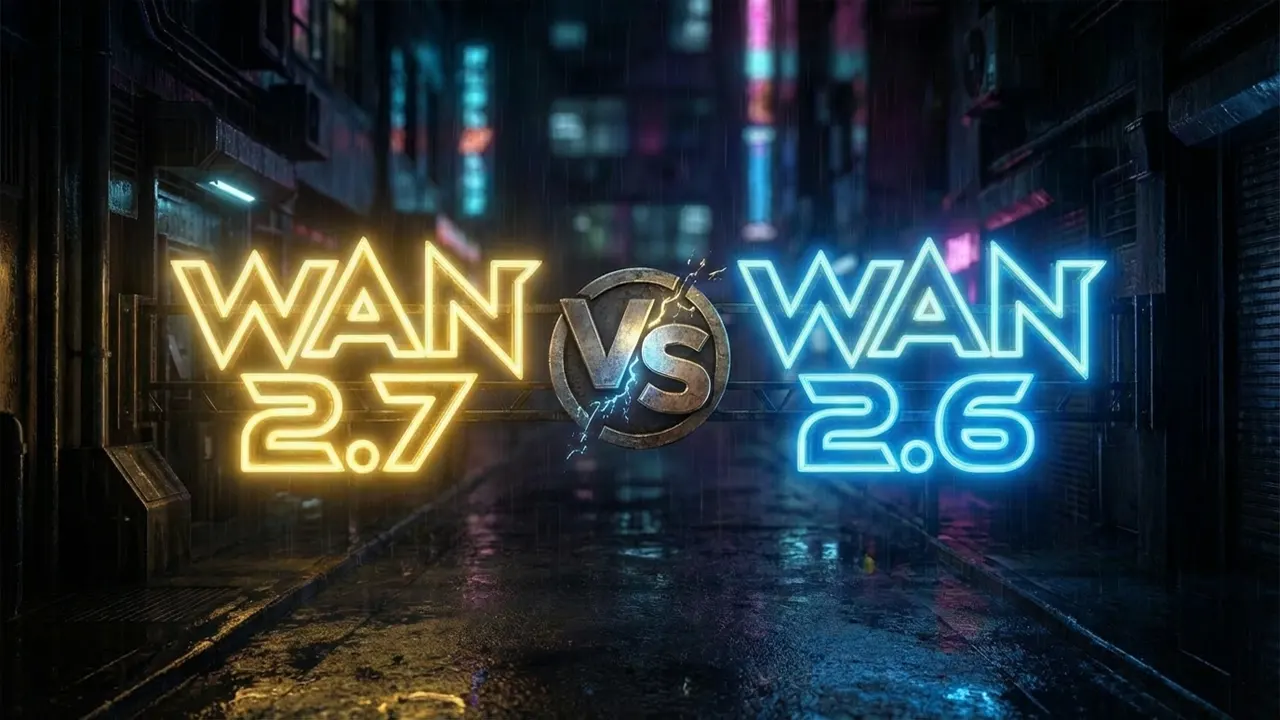
Wan 2.7 launched in March 2026, three months after Wan 2.6. The spec sheet tells part of the story — a bigger MoE architecture, five new capabilities, better quality across the board. But specs don’t show you what the output looks like. Video does.
Below are side-by-side comparisons generated on A2E with the same prompt, same settings. Judge for yourself.
Key Differences at a Glance
| Wan 2.6 | Wan 2.7 | |
|---|---|---|
| Architecture | Built on Wan 2.2 MoE | Built on Wan 2.2 MoE |
| Image-to-Video | Single image | Single + 9-grid NEW |
| Frame Control | — | First & last frame NEW |
| Video References | 1–3 clips | Up to 5 clips UPGRADE |
| Voice Reference | R2V with appearance + voice | Enhanced subject + voice control UPGRADE |
| Editing | Regenerate only | Instruction-based NEW |
| Video Recreation | — | Yes NEW |
Motion Quality
* All examples show Wan 2.7 on the left and Wan 2.6 on the right.
Multiple moving elements at once — dog, frisbee, waves, sand. Wan 2.6 tends to lose temporal coherence; Wan 2.7’s MoE architecture keeps everything in sync.
Prompt: A golden retriever chases a frisbee across a windy beach, waves crashing in the background, sand kicked up in slow motion, camera tracking sideways
Visual Detail & Color Accuracy
Macro-level detail — water droplets, knife reflections, fish texture. This is where Wan 2.7’s finer texture preservation and color accuracy pull ahead.
Prompt: Extreme close-up of a chef’s hands slicing sashimi, water droplets on the fish, knife reflection catching warm kitchen light, shallow depth of field, slow deliberate motion
Character Consistency
Three shots, one character, same face and outfit throughout. Wan 2.6 typically drifts by shot 2; Wan 2.7’s multi-reference consistency holds across all three.
Prompt: A woman wearing a red top paired with a polka dot skirt: shot 1 – walking toward camera on a city street; shot 2 -sitting at a café table drinking coffee; shot 3 – laughing while holding the cup; same face and outfit across all shots
Audio-Visual Sync
Three layers of sync — finger strumming, mouth movements, ambient sound. This is a stress test that exposes Wan 2.6’s sync limits.
Prompt: A street musician plays acoustic guitar and sings on a busy corner, fingers strumming in rhythm, mouth movements matching the lyrics, ambient city sounds in the background
Stylization Range
An extreme non-photorealistic style push — hand-painted watercolor, ink splatter, Ghibli aesthetic. Wan 2.6 often breaks down here; Wan 2.7 holds the style.
Prompt: A samurai standing in heavy rain, Studio Ghibli animation style, hand-painted watercolor textures, dramatic ink splatter effects, wind blowing through his hair
Which One Should You Use?
Pick Wan 2.7 when quality, consistency, and creative control matter — campaigns, storyboards, client-facing content, anything with multi-shot or voice.
Stick with Wan 2.6 when speed and volume are the priority — bulk A/B tests, quick drafts, cost-sensitive pipelines where “good enough” ships faster.
Wan 2.6 generates video. Wan 2.7 goes further with generation, editing, and recreation. Same family, different weight class. Both are live on A2E, so you can run your own comparison. Wan 2.6 is available to all users, while Wan 2.7 is currently in early access. Ultra subscribers get first hands-on as we scale it up.